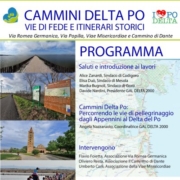


Un viaggio lento tra natura, storia e spirito di comunità
La terza via europea di pellegrinaggio celebra il successo di Cammini Aperti 2024, un progetto che ha valorizzato i cammini italiani all’insegna della lentezza, dell’accessibilità e della sostenibilità.
Il weekend del 14 aprile ha segnato la brillante conclusione di questa iniziativa, che ha intrecciato un filo di scoperta attraverso 42 escursioni in tutto il Bel Paese: 2 per ogni Regione e Provincia Autonoma, con la partecipazione entusiasta di migliaia di amanti del trekking e dei cammini.
L’iniziativa ha aperto le porte a un turismo lento e sostenibile, invitando camminatori di ogni livello a immergersi nei paesaggi italiani, riscoprendo il valore di un passo consapevole e rispettoso dell’ambiente.
In questa edizione, la Via Romea Germanica ha brillato con un percorso incantevole in Alto Adige, lungo il fiume Isarco. I partecipanti hanno potuto assaporare la maestosità di paesaggi mozzafiato e fortezze storiche. Nel Veneto, il cammino di Monselice si è rivelato un vero gioiello, un anello di 4 km che ha fatto eco alle parole di Cibotto, definendolo “la passeggiata più bella del Veneto”.
In altre parti d’Italia si sono svolti eventi collaterali come a Forlì, dove più di 100 persone hanno esplorato 5 km di storia, natura e biodiversità lungo l’argine del fiume Ronco. Questa iniziativa è stata anche l’occasione per contribuire al monitoraggio di un tratto della tappa n° 25 e dello stato della segnaletica dopo l’alluvione che ha colpito la Romagna nel maggio del 2023.
L’Orvieto Walking Marathon ha registrato un’affluenza record di 1200 iscritti, confermando la Via Romea Germanica come partner d’eccellenza.
Cammini Aperti è stato un’occasione unica per prendersi il tempo di scoprire e ri-scoprire il proprio territorio a passo lento, ammirando con occhi nuovi paesaggi incontaminati, borghi pittoreschi e siti archeologici di grande valore. Un’esperienza che ha permesso di valorizzare il patrimonio italiano e di sensibilizzare il pubblico verso l’importanza della tutela dell’ambiente e della promozione di un turismo sostenibile.
Un ringraziamento va a tutti coloro che hanno reso possibile questa iniziativa: associazioni, enti territoriali, volontari e, in modo speciale, le guide ambientali, cuore pulsante di questa avventura.
Mentre l’edizione 2024 si archivia tra i ricordi, lo sguardo si rivolge già al 2025, anno del Giubileo. La Via Romea Germanica si propone come itinerario ideale verso Roma, promettendo un viaggio di fede e spiritualità. Un cammino che invita a scoprire l’Italia con rispetto e amore per l’ambiente e le sue comunità.

After the weather events that occurred in Romagna in May 2023, creating serious problems in the plains (floods) and in the hills (landslides and mudslides) there were serious problems for the road system, both state, provincial and municipal. But the Paths also had their own problems that are being worked on, mainly thanks to municipalities, associations and private individuals.
The Ravennate area was fixed soon by the Emilia-Romagna Region’s Safety and Civil Protection offices. The embankment of the Ronco-Bidente River has been totally rebuilt by the same Regional Offices; the paths that are used by the pilgrims-walkers of the Via Romea and by the many and many local people and families who traveled them daily, on foot, by bicycle, with their dog friends, etc., etc., remain to be fixed.
In the hills, the Via Romea has provided “local variants” to get around some landslides; others have been fixed. Some, on the other hand, are passable with caution while waiting for complete repair. We sincerely thank all those who worked to restore the area.
It is important for the “tourist development” of our hilly , mountainous and inland areas that the trails are usable and that tourists are not frightened by the real or supposed difficulties. That is why it would be necessary for those in charge of ” tourism”(regional competence) to also help associations and municipalities to re-establish these connections.


The variant was necessary because the bridge crossing the Po at Polesella is difficult to reach because of long access ramps and, above all, there is a ban on pedestrians and cyclists crossing it, even behind the guard-rail.
The “historic” route remains on the right Po embankment (Emilia-Romagna; Municipalities of Ro, Francolino-Ferrara), but it is unsafe, at least until authorities make the bridge at Polesella safe to cross.
On the left embankment (Veneto; municipalities of Polesella, Canaro, Occhiobello) there is a very nice pedestrian and bicycle path, with some rest areas, and it reaches the bridge over the Po at Santa Maria Maddalena, after going under the railroad bridge.
The bridge is made of iron, it is level with no access ramps; on the two sides there are walkways (perdon and bicycle) of sufficient width for bikes and pedestrians to pass.
Then one enters the built-up area of Pontelagoscuro, on roads with sidewalks, little traffic and considerable stretches of proper bike path.
This leads to the walls of Ferrara and rejoins the “historic” route on Via Azzo Novello.
Signs of the route from Rome to Stade have also been placed.
The “historic” route has a length of 22.2 km (from Polesella Bridge to the center of Ferrara); the “variant” route is 24.2 km.
There are no height differences.


Once again this year the “Do the Right Thing” event curated by Terre di Mezzo was held at the Milan Fairgrounds. An important event attended by thousands of enthusiasts, especially young people.
The Via Romea Germanica was also actively present, enjoying the availability offered by the APT of Emilia-Romagna, which is also our very important partner.
The latest developments in our activities were reported, including our new Official Guide, which since November has been available to walkers and cyclists who want to ride the Via Romea (www.guidaromea.eu).

Initiative in Romagna, in the municipality of Bagno di Romagna.
An invitation to participate!


There is growing interest in the Via Romea Germanica and the opportunities for networking between neighboring territories to promote slow tourism, coordinated and connected routes, and development.
In the space of a few days, the Italian Via Romea Germanica Association, with its president Flavio Foietta, participated in two different and important meetings with public administrators, entities and economic operators in the Province of Rovigo interested in connecting to the historic pilgrim route described by the monk Albert of Stade in 1200.
As happened in other areas, the availability of the Via Romea Germanica is there, also to connect and promote alongside the main historical route variants and local itineraries, also among others traveled by pilgrims over the centuries.
This is evidenced by the discovery, in the area between Ariano Polesine and Chioggia, of a number of “medallions” from the 1200s/1300s that pilgrims wore on their return from Rome as a sign of the pilgrimage they had made.
A number of these “insignia” are on display at the Diocesan Museum in Chioggia.
It was precisely at the day of meeting and discussion promoted by ConsorzioPoolService and initiated at the San Basilio cultural center in Ariano Polesine that the foundations were laid for a collaboration with the Via Romea Germanica, which was also represented by Councilor Luigi Polo.
Participants included ConsorzioPoolService president Fabio Biolcati with vice president Sebastiano Bruschi, Ariano Polesine councillor Sandro Vidali, Consorzio Po e il suo Delta president Daniele Grossato, Gal Polesine Delta del Po president Sandro Trombella with director Stefano Fracasso, and Davide Bellotti for Consorzio Navi di Comacchio.
A few days earlier Foietta spoke at a conference in Pincara, in the province of Rovigo, to discuss a cooperation project between Local Action Groups from Veneto and Emilia-Romagna that aims to develop routes and promotion “from the Po Delta to the Apennines.”
Also in this case, the availability of the Via Romea Germanica is maximum and Foietta stressed the importance of the association’s presence and participation also to ensure coordination and homogeneity of interventions for what concerns paths, signage and maintenance, as well as for the overall promotion of the territories.
Present in Pincara were the mayors of the municipalities (all in the province of Rovigo) of Pincara Stefanio Magon, of Salara Lucia Ghiotti and of Ceneselli Angela Gazzi, and the president of Gal Polesine Delta Po Sandro Trombella.

Three pilgrims-Norwegian Nan and Danes Lotte and Egon-started from Oslo and after about 2,000 kilometers on foot arrived in Santa Sofia and Bagno di Romagna as part of the “Pilgrim Open Horizon” program that left Oslo on May 1.
A walk that requires strength, physical and mental residence, and determination.
In Bagno di Romagna they were welcomed by City Councilor Claudia Mazzoli and Via Romea President Flavio Foietta, as well as other friends who walked with them for two stages.
Happy walking!